Link to video
Showing posts with label physics. Show all posts
Showing posts with label physics. Show all posts
Monday, May 23, 2016

Monday, August 10, 2015
Moseley
An early physics pioneer you rarely hear about is Henry Moseley, who died 100 years ago today. Moseley made an important discovery now called "Moseley's Law."
Up until Moseley's time, chemical elements in the iconic Periodic Table were arranged according to weight. There was other rhyme and reason to the arrangement of elements in the Table, but no true understanding of their masses beyond: things get heavier. There was hope that atomic mass would reveal something fundamental about physics, and the 1914 Nobel Prize went to Harvard's T. W. Richards for his careful and methodical measurements of atomic weights.
Moseley showed that by shining X-rays onto atomic samples, he got a distinct integer value for each element which he called Z. Others before Moseley -- namely Bunsen and Kirchoff -- had shown how unseen atoms could be "seen" and identified by burning them in flames, but Moseley's experiments were beautifully simple and related all elements together with their Z-values instead of getting a unique "fingerprint" for each. Moseley's law is still used to identify elements in deep space.
Exactly what Z was had only been postulated a few years earlier. Niels Bohr had shown that Z was the nuclear charge (1 for the hydrogen atom) and Ernest Rutherford had suggested that Z for heavy atoms might be about half an element's atomic weight. A Dutchman, Antonius van den Broek had suggested that Z was an element's "atomic number" and Moseley proved it.
Good ideas need good proof to be good science.
The Periodic Table was never the same after Moseley.
Henry Moseley probably should have gotten the 1915 or 1916 Nobel Prize in Physics, but he was killed by a Turkish bullet at Gallipoli at age 27.
Isaac Asimov wrote: "In view of what he [Moseley] might still have accomplished ... his death might well have been the most costly single death of the War to mankind generally."
Up until Moseley's time, chemical elements in the iconic Periodic Table were arranged according to weight. There was other rhyme and reason to the arrangement of elements in the Table, but no true understanding of their masses beyond: things get heavier. There was hope that atomic mass would reveal something fundamental about physics, and the 1914 Nobel Prize went to Harvard's T. W. Richards for his careful and methodical measurements of atomic weights.
Moseley showed that by shining X-rays onto atomic samples, he got a distinct integer value for each element which he called Z. Others before Moseley -- namely Bunsen and Kirchoff -- had shown how unseen atoms could be "seen" and identified by burning them in flames, but Moseley's experiments were beautifully simple and related all elements together with their Z-values instead of getting a unique "fingerprint" for each. Moseley's law is still used to identify elements in deep space.
Exactly what Z was had only been postulated a few years earlier. Niels Bohr had shown that Z was the nuclear charge (1 for the hydrogen atom) and Ernest Rutherford had suggested that Z for heavy atoms might be about half an element's atomic weight. A Dutchman, Antonius van den Broek had suggested that Z was an element's "atomic number" and Moseley proved it.
Good ideas need good proof to be good science.
The Periodic Table was never the same after Moseley.
Henry Moseley probably should have gotten the 1915 or 1916 Nobel Prize in Physics, but he was killed by a Turkish bullet at Gallipoli at age 27.
 |
| Henry Moseley (1887-1915) |
Wednesday, August 5, 2015
Thursday, February 12, 2015
No Big Bang?
"The universe may have existed forever, according to a new model that applies quantum correction terms to complement Einstein's theory of general relativity. The model may also account for dark matter and dark energy, resolving multiple problems at once."

"The Big Bang singularity is the most serious problem of general relativity because the laws of physics appear to break down there," Ahmed Farag Ali at Benha University and the Zewail City of Science and Technology, both in Egypt, told Phys.org.
Ali and coauthor Saurya Das at the University of Lethbridge in Alberta, Canada, have shown in a paper published in Physics Letters B that the Big Bang singularity can be resolved by their new model in which the universe has no beginning and no end.
Saturday, December 14, 2013
"Scientists Discover a Jewel at the Heart of Quantum Physics"
"Physicists reported this week the discovery of a jewel-like geometric object that dramatically simplifies calculations of particle interactions and challenges the notion that space and time are fundamental components of reality."
"The revelation that particle interactions, the most basic events in nature, may be consequences of geometry significantly advances a decades-long effort to reformulate quantum field theory, the body of laws describing elementary particles and their interactions. Interactions that were previously calculated with mathematical formulas thousands of terms long can now be described by computing the volume of the corresponding jewel-like “amplituhedron,” which yields an equivalent one-term expression." (via Instapundit)
It all sounds so sentimental... but
"The revelation that particle interactions, the most basic events in nature, may be consequences of geometry significantly advances a decades-long effort to reformulate quantum field theory, the body of laws describing elementary particles and their interactions. Interactions that were previously calculated with mathematical formulas thousands of terms long can now be described by computing the volume of the corresponding jewel-like “amplituhedron,” which yields an equivalent one-term expression." (via Instapundit)
It all sounds so sentimental... but
Saturday, November 23, 2013
"Brightest Explosion In the Universe Ever Seen Defies Astronomy Theories"
"The really cool thing about this GRB (gamma-ray burst) is that because the exploding matter was traveling at [nearly] the speed of light, we were able to observe relativistic shocks," study co-author Giacomo Vianello, a postdoctoral scholar at Stanford University in California, said in a statement. "We cannot make a relativistic shock in the lab, so we really don't know what happens in it, and this is one of the main unknown assumptions in the model. These observations challenge the models and can lead us to a better understanding of physics."
Live Science beta
Live Science beta
Tuesday, October 8, 2013
The Nobel Prize In Physics Has Gravitas
The Nobel Prize in Physics 2013 was awarded jointly to François Englert and Peter W. Higgs "for the theoretical discovery of a mechanism that contributes to our understanding of the origin of mass of subatomic particles, and which recently was confirmed through the discovery of the predicted fundamental particle, by the ATLAS and CMS experiments at CERN's Large Hadron Collider" link
Now one of you geniuses please explain the Higgs Boson to us.
Chemistry is announced tomorrow. I'll get back to you. Carl Djerassi is someone I've long thought should get it but he probably never will.
Added: Lem links an animated lesson:
Lem Learning Gravitas
Now one of you geniuses please explain the Higgs Boson to us.
Chemistry is announced tomorrow. I'll get back to you. Carl Djerassi is someone I've long thought should get it but he probably never will.
Added: Lem links an animated lesson:
Lem Learning Gravitas
Thursday, August 29, 2013
The Grindstone
Having a wheel and four legs of its ownHas never availed the cumbersome grindstoneTo get it anywhere that I can see.These hands have helped it go, and even race;Not all the motion, though, they ever lent,Not all the miles it may have thought it went,Have got it one step from the starting place.~from Robert Frost's The Grindstone (1923)
__________________________
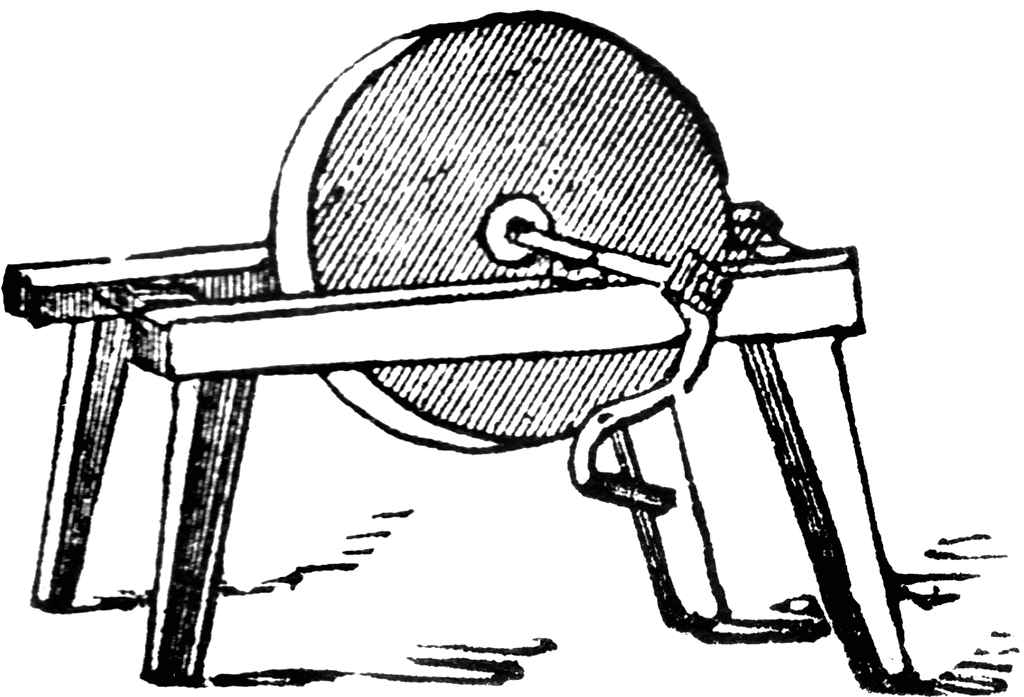
A grindstone belonged to my grandma's yard when I was little. It stood outside withstanding Wisconsin weather year after year. I saw it once a month or so on Sundays when we visited. I guess it had been my grandpa's and maybe his father's before that but they were already dead by then and I forgot to ask my dad about it too. My dad never farmed for a living and so the grindstone never passed down. He showed me other useful things.
A grindstone must have been handy on a farm in the days of steel plows and scythes. I never saw it make sparks fly but it must have done that in its day. Come to think of it, that's probably why it was outside (and why Frost's grindstone was outside too). It's not the kind of tool to keep and use in a barn around sawdust or straw. But farming changed and that grindstone became a relic—a sort of lawn ornament and a plaything for me, my brother, and my cousins while the grown-ups chatted inside.
No doubt that grindstone had abetted the killing of countless blades by whetting blades, but those of the surrounding weeds by then outnumbered the kind that this device had sharpened. I thought of none of that then. It was enough to just play with it and turn its heavy wheel. A fixed handle cranked the stone disk around and around. Getting it going really fast and then letting go of the handle made it hard to grab it again without getting hurt—such was its angular momentum. But that's not what I called that force then. I didn't know what to call that force then—I just knew that the grindstone had it and I never forgot it. And though that grindstone is long gone, it was a starting place for lessons learned many years on.
Subscribe to:
Posts (Atom)