What's a lyre you might ask? It's an instrument which used to inspire lyrics. Here's what a lyre may have sounded like in end times at the town of Har Megiddo.
Showing posts with label fish. Show all posts
Sunday, June 2, 2019
Lyre, Lyre, World On Fire
Another animal sporting a lyre-tail is the neolamprologus brichardi, also know as the lyre-tailed cichlid:
Back in the day when I collected aquarium fish, that was as good as it got for grace and beauty in a tropical fish; the pink flesh, the bluish eyes and blue-fringed fins -- this fish beat all other freshwater fish on aesthetics. Note that I wrote freshwater because I never graduated to saltwater aquaria.
What's a lyre you might ask? It's an instrument which used to inspire lyrics. Here's what a lyre may have sounded like in end times at the town of Har Megiddo.
Saturday, September 2, 2017
"Human mood drugs end up in Great Lakes fish"
Via Instapundit: Antidepressant drugs, making their way through an increasing number of people’s bodies, getting excreted in small amounts into their toilets, and moving through the wastewater treatment process to lakes and rivers, are being found in multiple Great Lakes fish species’ brains, new research by the University of Buffalo has found.
Researchers detected high concentrations of both the active ingredients and metabolites — byproducts of the parent drug — of popular antidepressant pharmaceuticals including Zoloft, Prozac, Celexa and Sarafem in the brains of fish caught in the Niagara River connecting Lake Erie and Lake Ontario. . . .
Previous research has shown antidepressants in water create “suicidal shrimp” that swim toward light instead of away from it, making them vulnerable to predator fish and birds, Aga said.
“Other research teams have shown that antidepressants can affect the feeding behavior of fish, or their survival instincts,” Aga said. “Some fish won’t acknowledge the presence of predators as much.”
Researchers detected high concentrations of both the active ingredients and metabolites — byproducts of the parent drug — of popular antidepressant pharmaceuticals including Zoloft, Prozac, Celexa and Sarafem in the brains of fish caught in the Niagara River connecting Lake Erie and Lake Ontario. . . .
Previous research has shown antidepressants in water create “suicidal shrimp” that swim toward light instead of away from it, making them vulnerable to predator fish and birds, Aga said.
“Other research teams have shown that antidepressants can affect the feeding behavior of fish, or their survival instincts,” Aga said. “Some fish won’t acknowledge the presence of predators as much.”
(Link to more)
Monday, March 2, 2015
fish
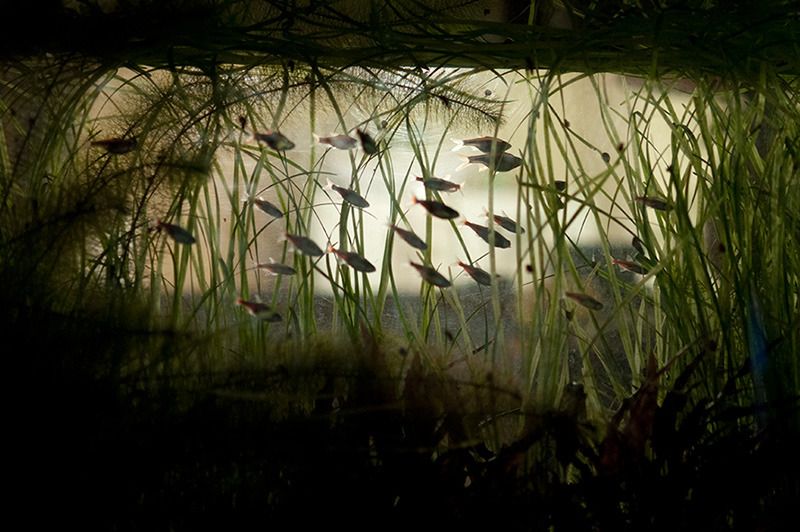
Their lights go out and they do this each night, a regular thing since the lights are on a timer. They do the same thing around noon without a cue from the lights; bunch up in the middle of the tank and hang there in space for hours on end.
When they wake up they're hungry. For flakes. Flakes, flakes, flakes, flakes, flakes, that's all they ever eat. They're very picky. I tried to turn them on to other things, but they're not having it.
Half of these fish originate from the Rio Negro. I just checked the temperature of Rio Negro, one chart shows a range from 50℉ to 68℉. That is colder than I thought it would be.
Seems like I just stripped this thing out and now it's overgrown again. The fish like it overgrown.
Wednesday, February 25, 2015
"Justice Kagan uses Dr. Seuss in case argument"
"In a 5-4 decision announced Wednesday, the Supreme Court ruled that the law was meant to apply only to records or information documents."
But in her dissent, Justice Kagan argued that fish should be included in the “tangible object” category of evidence the law describes.
“A fish is, of course, a discrete thing that possesses physical form,” she wrote. “See generally Dr. Seuss, One Fish Two Fish Red Fish Blue Fish (1960).”
Link to Sopranos fish scene on YouTube.
During oral arguments in November, things sometimes took a turn for the absurd, as justices debated the legal nature of fish and whether a fish could count as a record if information was carved into its scales.
Sunday, October 20, 2013
Tuesday, August 13, 2013
The Secret Ingredient: Anchovies
![]() |
| Detail from a Roman mosaic from Pompeii, now at the Naples National Archaeological Museum |
In my previous post, my recipe for cold summer spaghetti, there was some discussion of anchovies, as my recipe includes some anchovy fillets. I think that anchovies are one of the most versatile ingredients in cooking, and that any well-stocked kitchen should have some on hand.
The wonderful thing about anchovies is that you can keep them on hand. In fact, the true value of anchovies comes only after they are preserved. I think that fresh anchovies, while perfectly good to eat, are nothing really special. It is the natural alchemy of fermentation, a process controlled by preservation of the fish, that transforms these tiny, multitudinous fish into gustatory glories.
![]() |
| Kikunae Ikeda |
Aside from the nice salty, slightly fishy taste of the anchovies themselves, they also carry their cargo of glutamates to enhance the flavor of anything they're added to. When used in small quantities in recipes, they quietly exert their influence without ever being noticed as themselves. The addition of just an anchovy fillet or two will improve the flavor of many dishes and because the fillets just "dissolve" when cooked no one, not even anchovy haters, will know why the meal tastes so good.
For these reasons, anchovies have been used for millennia to augment the flavor of foods. The ancient Romans made a sauce called garum from fermented fish (and parts of fish) including anchovies, that was one of the pillars of their civilization. The concept of using fermented fish to enhance the flavor of foods appeared in many different cultures, from Asian fish sauces to recipes such as those found in 18th century English cookbook writer Hannah Glasse's "The Art of Cookery". Here are a couple of recipes I scanned from my (now sold) 1778 copy of the book:
![]() |
| Page 243 of the 1778 London edition of Hannah Glasse's The Art of Cookery, Made Plain and Easy |
I once made the "Catchup to keep twenty Years", though it didn't last more than a year because it was so delicious and everyone wanted a bottle. The ancestor of these sorts of recipes lives on in Worcestershire sauce, which includes many of the same ingredients such as, of course, anchovies.
Most anchovies that you can buy are good, though I think that the salted ones taste the best. Salted anchovies keep very well in the refrigerator as long as you keep them covered in their salt. They're a little more work, because you have to soak them before use and you may need to fillet them yourself as the salted ones are often whole. These Italian salted anchovies are very good. If you like your anchovies to be less work, these bottled, oil-preserved anchovies made by Ortiz are also great. If you're in the New York City area, Fairway sells these French oil-preserved anchovies that are absolutely delicious.
So next time you're cooking beef stew, or meatloaf, or fish, or even hamburgers, slip an anchovy fillet into the mix. Everyone will rave, and no one will suspect that part of the reason is a secret little fish.
Labels:
anchovies,
Cooking,
fish,
food,
Hannah Glasse,
Palladian,
Rome,
Secret Ingredients
Subscribe to:
Posts (Atom)