Showing posts with label sourdough starter. Show all posts

Thursday, August 18, 2016

offer to Lem's Levity readers: free sourdough starter


This is impressive sourdough starter. It is powerful, strong, fast, and its flavor is fantastic. You may have it for free. 

I will mail an ample tablespoon to you. Email your address to

boure AT AT comcast Dot Dot Net. Obviously repair that address. I will not keep your mailing address nor use it or sell it. Scouts honor.  *holds hand on Scout Handbook* 

If you'd like to try your hand at sourdough by taking this offer you'll  miss the most amazing and fun part. It really is fun and I think exciting to collect your own starter and that has the advantage of originating from your own location. And you can be careless in handling forevermore because your local airborne organisms cannot contaminate your own sample. Over time eventually they will invade. 

It's childsplay. And it's done by various means. This sample is strong because I totally overdid the whole collection process on purpose.  

Chefs simply add water to flour to pancake-thick batter, a flour slurry about a cup, and let it sit in a jar for a few days at room temperature. The organisms present on the flour will activate and by the third day a few tiny bubbles appear. They always do. I've done it a dozen times at least. It is a reliable method. In that case the organisms originated from the place where the wheat was grown. Most likely Nebraska. It is a solid technique. Wheat fields are yeasty places.

This starter slurry was left outside so it has those organisms from the flour plus any blowing around in the atmosphere carried to it by wind shoving them into slurry out there. I wanted it to rain into my slurry, a few times. I left it out there for a whole week unnecessarily. I was very careless with handling, debris also flew in too, bits of grit, tiny twigs, a few bugs had to be picked out. It stank. (But not so bad as the samples collected in Hawaii in just a few hours. Hawaii's conditions are incredibly rife with yeast and bacteria that makes its own type of sourdough) One tablespoon is used to inoculate a new batch of pancake-thick slurry and the bread dough developed from that. This is the fun part. When you see your slurry come alive to full on bubbling, well, it's just amazing. 

The first time I called my science teacher friend and put on Igor's voice, "It's alive!" 

What I will do is prepare another batch of wet slurry from full on bubbling mixture, very wet dough without salt, bring it to full bubbling state and spread it out on a baking tray. Allow it to dry, scrape it off, process it to powder, seal in a sandwich bag and mail it to you, if you would like to have this incredibly powerful and fast and delicious starter. Much stronger than the San Francisco starter that you can buy. Understand though that you can do the same thing at your place. 

These bits shown above have been languishing in the freezer for the last two years. I used one teaspoon and mixed it with 1/4 cup water and enough flour to make the pancake-thick slurry. Covered the small bowl and let it sit for three days to reactivate. 

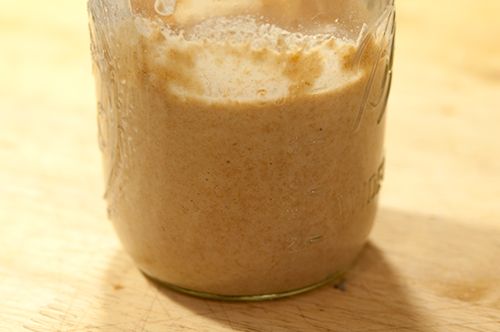
It came back to life overnight showing a few bubbles on top the next day, on day two there were many more bubbles, pictured above. Day three the bubbles popped and slurry thinned. Today is day three, I added more flour to thicken the tiny batch to nearly proper dough and it doubled in size and filled its bowl to the top.

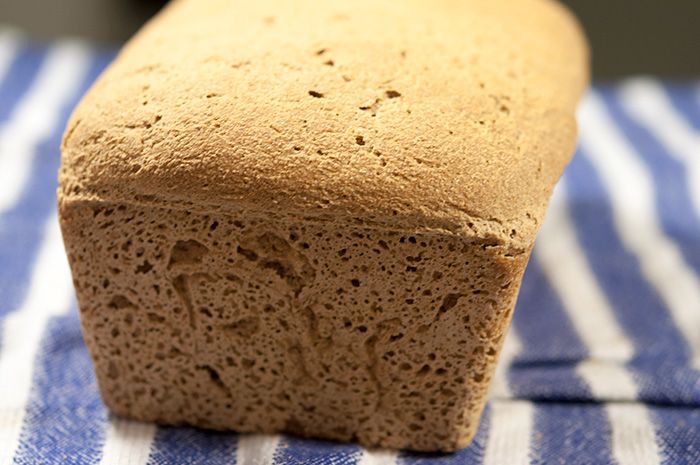
A loaf of bread can be made directly from that using only this sourdough culture. 

My intention was to use a small portion of fermented slurry to flavor regular bread using regular yeast and that is what I did tonight. But my small portion grew completely out of hand. I used only half. The rest is fed a tablespoon water and fresh flour and put in the refrigerator. The culture is so strong that cold storages does not hamper it. It will continue to rise in there. It's on! This culture will take over the world if I let it. 

Even diluted this way the sourdough the baked bread is stronger than the loaves that I buy. I don't know what the commercial places are doing but they don't come even close to my own 100% sourdough. No contest. I win. Hands down.

When I told this to the workers at Tony's Market nearby, they're all foodies there and interested in this sort of thing, they didn't believe me. I gave them a loaf and it blew their minds when they ate it. They had no idea you can make bread with the flavor unique to your own place. But you can. And if you're sufficiently careless and let the collecting go for a week, refresh the collection as you go, add water if it dries out, now and again, just try to keep it wet and stir in the dried edges, then it can be powerful as this.

A mere tablespoon is taken from that  mess of a collection and used to inoculate a fresh batch that is brought to full bubbling. And there is your new culture, made powerful by the hardship it suffered, and unique to your place. 

Sourdough rises much more slowly than commercial yeast does, that is a selected organism isolated for being particularly farty. But this Denver culture is nearly as fast. It should take about 8 hours to rise once the culture is going full blast, all the other cultures I collected other places do, but this one is much faster than all the rest. The bowl today puffed up in four hours. I was stunned that the culture is that active.

Now my entire apartment smells of baked sourdough bread. 

All this for a mortadella sandwich. An enviably delicious and simple bologna sandwich. There is nothing else like it. And I'm not exaggerating for dramatic effect either.  I diluted this bread on purpose, and I did not have the final dough ferment as serious bakers do to develop the sourdough flavor further. It's not needed. I  just got on with baking a loaf.And it's still stronger sourdough flavor than you can buy from a bakery. Any bakery. Were I to ferment a finished loaf as sourdough books tell you to do, then the bread would become too acidic. It would take the whole project too far. 

In liquid terms it would be Guinness on steroids. 

Thursday, January 15, 2015

sourdough in a bread machine

Q: We got a bread machine for Christmas. How do we use the machine to make sourdough bread?

A: If you make a slurry out of flour and water to the consistency of thin pancake batter, and set it outside for a couple of days to collect airborne organisms floating around in the air, then that will be enough to cultivate with consistent 95℉ heat to a fully active sourdough starter within another twenty-four hours.

The longer the slurry is out there, even if refreshed with new water, then the more complex the culture, the more active, the faster and stronger the culture. The more it endures out there the better. Better to be rained on a few times bringing water from the sky right into it. If it is hot outside then the culture will most likely begin cultivating on its own while it is collecting. On Maui this happens in one day. Within a few hours, actually. Wind blows organisms directly into your slurry and conditions are already perfect. The more wind the better.

If collected in winter and kept from freezing by careful in and out attention, especially if it is windy then the organisms collected over time will be cold-enured. Loaded with organisms that survived extreme cold and revived when conditions improved. This is crucially important when fermenting because the cold storage will have very little affect, it will keep right on going if only a bit slower.

Back inside, the yeast in your jar has a schedule to be fed. Whatever you have there, swirl it around and use a teaspoon of it to inoculate a bowl or jar of fresh slurry and let the inoculated bowl or jar sit there for eight hours at room temperature, and watch it. Observe if it peaks at eight hours or if it continues to rise slowly to the twelfth hour. The faster it reaches peak then the more robust.

Then feed it again with more water and more flour. Observe again at eight hours, but be patient to twelve hours. 

Feed it again with fresh flour and fresh water, doubling the mass with each feeding and you quickly realize you must do something with this, break off the largest portion to bak or discard and continue feeding a smaller amount down to, say, 1/4 cup. Either discard the surplus or add flour to it and salt for a loaf and bake it. One or the other. 

The whole project can quickly get out of hand with regular feedings that double the bulk.

This is what makes sourdough so demanding. It's why bakeries can do it better than home cooks can. It takes too much dedication. 

When the yeast culture you have is fed the organisms gobble up the new food, foam up and peak then fall back. The point where it peaks is your culture's schedule. It can be anywhere from eight to twelve hours. 

You can force the issue and have yeast so powerful and so fast that it peaks within eight hours. Or you can slow to twelve. You force the issue by sticking to a schedule and those organisms that do best on your schedule survive to thrive and predominate. It is a demanding routine and few people are up to it. There is some margin for error, but not much. 

But I learned that all that does not on its own make bread sour. It makes it different, and better, but not sour.

The point of all this regular feeding is to get the starter going full blast on a regular basis, then use it to produce a loaf of bread by adding flour to stiffen it. And right near its peak, because you know your culture so well, cover the dough early and stick it in the refrigerator to chill, to slow down, and to ferment. It must age a few days for the bacteria colonies to grow and develop as much as the yeast has. Get it chilled before it peaks, so the yeast can pick up where they left off once it is out again at room temperature or warmer.

It is the culture starter and the fermentation period that makes the bread sour. This is how you make strong sourdough. You control how strong it is by how long you let the finished dough ferment.And this is how you can get it to be really sour, by extending the fermentation period.

You can do the same thing with commercial yeast, but as a single cell type it will not be as complex, it will be improved but not be very sour.

Sourdough starter is  like a pet. 

One that you occasionally starve, here and there.

It needn't be captured in slurry from air. That's just a way to have sourdough unique to your area. It also starts from the yeast already on the flour. The yeast on the flour that makes the slurry to capture more airborne are fewer in number than in the air, they are combined, duke it out, have a war, and the airborne organism prevail. 

If you have a race between two jars, one plain slurry started fermenting on its own, and another outside collecting more organism, the first one wins the race and makes a fine culture itself, although of uncertain origin. You have no idea whence the grain and neither does the person or company that milled it. Grains are combined to make flour. Sometimes Whole Foods can tell you precisely where their wheat seeds come from. They can order a specific type. Either way, volunteer starter, or active collection starter, the results are worth the effort especially if  you go through a lot of bread. Nothing beats it. Once you get the hang of it, how it behaves. I think it's fun. I don't mind having a pet around for awhile, but that means I'll be cranking out a lot of sourdough bread just as part of keeping the culture at 100% peak activity.

I do this for fun wherever I go. That's why I have about a dozen different cultures in powder form and in frozen powder form, and in thick sludge form, and only one in wet 1qt jar form.

There is another way to use the languishing sourdough culture not at peak activity as flavoring to regular dough made the regular way in the machine. It's a cop out. It is what a lot of bakeries do, merely flavor regular commercial yeast with aged chilled languishing sourdough culture.

Incidentally. the last time I collected a culture, this summer for fun, I left it outside for two weeks. There was a period where it rained lightly every day. I wanted my culture to be strong as can be, and it is.

I talked about this to people at Tony's Market, an upscale market nearby. Even more expensive than Whole Foods, but a dependable bodega. They will have something so unusual as buffalo mozzarella. But things are expensive. Everyone there, from hipster, to jock, to immigrant type, whatever, every person I've talked to there and at Whole Foods too, are totally into their thing. Whatever department you're in, people are eager to talk about things. So I'm talking about this collecting yeast unique to Denver and my careless way of doing it, and the result. The person is 30-something, you'd have no idea that they are really interested. But they are. The questions he asked indicated amazement. He never thought any such thing possible. "It's a way to overcome allergies." 

So I thought what the heck. I have to produce more bread than I can consume when my culture is active. Either that or spill it away to keep the size manageable as I feed it. So I made an extra loaf, wrapped it white dinner napkin as if its a valuable thing, and took it to Tony's Market and gave it to the guy to show him what I am talking about. I went shopping. Returned to the checkout counter. He said by then everyone back there had tried it and were all mightily impressed. It is a very strong sourdough culture that ferments incredibly complexly. It is stunning. They were stunned. 

The guy goes, "I wrapped up what is left and not sharing anymore before it is gone. I'm hogging the rest for myself." 

Then he gave me his employee discount on top of my regular card-carrying discount which reduced my bill greatly, just for sharing my bread. That turned out to be a very profitable loaf of bread. Like $30.00 savings right there.

Plus I blew them away with the knowledge you can collect airborne organisms and cultivate them to produce awesome bread.

Awesome Opossum bread.

But see, all of this runs counter to the convenience of using a bread making machine. Either you are a dedicated baker or not. 

Even so, the guy who runs "Sourdough International" keeps several unique strains separated by continuously  feeding multiple strains and freeze-drying it, uses a bread baking machine too. I do not understand why. After all that, why a machine? It's his preference. I think the loaves come out in the shape of a cube.

When you get used to working with the dough, when you get the feel of it, you find a very wet, very stretchy dough lends itself to closed clay cloche technique for baking. Sort of a tight clay oven within an oven cranked all the way up to top heat. Rocket-hot clay. They can cause the dough to expand to maximum size, when dough is sufficiently wet, with largest internal holes and tight thin toasted skin, a light crunchy crust.

You can get them on eBay, intended for clay-roasting chickens. They have ridges built into the bottom so I use them upside down. I make the most incredible hamburger buns in them. Or a football-size loaf of bread. I have two of these, and a third one for long loaves of bread like a baguette except shorter.

I also have a large unglazed bowl that I turn upside down on a pizza stone to cover a round loaf of bread and contain the heat and the moisture closely long enough for it to expand by heat then toast hard at maximum expansion. They are all excellent. 


This one is $32.00 plus shipping on eBay. I see another one for $10.00. There are similar things. But then, at this point you are dedicated baker and that runs contrary to the convenience of the machine where you toss in the ingredients and it does everything. 

This is the sort of thing I talk to women about to the point that their husbands get mad at me. It happened. But the women are very interested in my discoveries and this is among the best. These three things make my sourdough bread better than what you can buy. It is. Because,

1) my culture comes from right here. It is Denver culture, it suffered many indignities, blew in from parts unknown,  and it is quite extraordinary.

2) it is formed into a loaf at peak activity and chilled before peaking in its cycle to ferment for at least three days, whereas five days is pushing it.

3) brought back to life in a heated kitchen, stretched and formed its yeast redistributed, and finishing its peak activity the refreshed dough  is stretched as it is dropped into a pre-heated cloche, covered and baked at high temperature. Something magical happens inside, the dough inflates like a million dough-balloons inside a dough-balloon providing a stretched skin that toasts.

Thursday, September 25, 2014

100% whole wheat

The problem with whole wheat is all that husk material makes a mess of things. It is too heavy and it damages gluten molecules while interfering with gluten's ability to connect with itself and to adjoining molecules making a sort of net that traps bubbles, the farts of yeasty fungi, like throwing handfuls of hay into nice stretchy dough.

I noticed this making tahini from sesame seeds. This is how thick I am sometimes. The bulk bins were labeled "sesame seeds husked" and "sesame seeds unhusked"

And I honestly could not tell which bin had seeds with husks and which bin had seeds stripped of husks. And I could not tell by comparing individual seeds either. Not without a loupe and an x-acto blade. So I bought both, and at home making them into pastes realized right off unhusked means they still have husks and, man, do they ever absorb a lot water. And its sesame flavor a bit muted. And both were a lot better than commercial tahini.

And now this is the same thing going on with wheat seeds.

Maybe a powerful sourdough starter can lift husky whole wheat where commercial yeasts cannot. Maybe it can interfere with the husk's interference if it were trained on whole wheat.

This sourdough starter right here collected just this week is fascinating. Let me tell you what I learned.


It is the second of two Denver cultures collected this summer, the third of three Denver cultures activated and used, the first is re-frozen the second discarded even though it was a superior culture. They are all superior these days.

I encountered a lengthy piece about a lazy way to catch a sourdough starter, the article was short enough, but the comments went on seemingly forever. 

Sidebar: something struck me back then while reading those comments. People actually went to college for this. They speak about yeast and chemical leaven and give dates and names and publications and history near and ancient. They begin their comment with *sigh.* 

Ewww, doesn't it make your skin crawl? They also begin, "I used to think as you do now, but then... [I saw the light]." 

So much arrogance evident and pride in academic knowledge and opinion and appeal to authoritah with no mention of direct experience. Women can be surprisingly wildly carelessly competitive bitches with each other. [/sidebar]

And in the comments people kept mentioning success rates with their approaches and I found those mentions very odd because I never had a failure.

I do this all the time, sometimes have a race to activation between the airborne collection slurry and another slurry of straight flour. (They both contain the same flour, so airborne collection begins with the same organisms in the same amount before being contaminated with airborne organisms) 

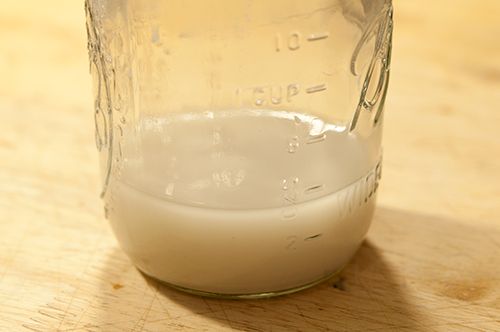
This last Denver culture is quite unusual. Collected carelessly over two weeks. It was sunbaked several days in a row, dried out nearly completely, was hailed on, rained on several times, wind battered for long periods, bits of plants flew in, a few tiny bugs were captured. It looked gross. The jar at top is half the liquid strained through a kitchen towel. (Coffee filter clogged, so did the Aeropress) 

Two weeks is a very long time to collect airborne organisms. On a good windy day you can do the same thing in an hour, just to show how ridiculous it is to collect airborne particles for two weeks. It's like not bathing for two weeks. These are the same organisms that make your own body stink in a single day with the same conditions of moisture and heat.

The liquid in the jar was fed whole wheat flour to turn it to paste and within four hours the mass sprang to life doubled in size with visible air pockets on the side of the jar and with a sweet odor. Shockingly fast. At room temperature.

That never happened before. 

I always used heat from a lightbulb. And it always took a day.

My aim is to gear it to whole wheat flour to produce 100% whole wheat loaves but those are always heavy as cinderblocks. Loaves made from nothing but milled wheat are the same thing as big pan of wheat seeds. Microscopically, the husks interfere severely with gluten strand formation, intermixed, microscopic husk particles, the material that makes great dietary fiber, slices adjoining gluten molecules as soon as they make connections and stretch like a billion tiny tight rubber bands stretching to increase elasticity within a solution of a billion tiny knives. 

The flour that makes the dough cannot interconnect inside, cannot form a gluten molecule matrix. It cannot form a skin. The particles remain discrete, baking the dough is like baking sand. The loaf cannot expand as we are used to.That it expands at all is amazing. The loaves bake more crumbly.

How do you get heavy wheat loaves to puff up?

Chinese cooks add baking soda to regular flour to make noodles that stretch impossibly long. They speak of lye-water, yes, they speak of 速溶蓬灰 for their noodles, but it is the same thing, jack with the pH. Similar deal with pretzels and with steamed dumplings.

Could baking soda exaggerate the gluten stickiness in whole wheat sufficiently to overcome the husk's interference? Could baking soda interfere with the husks in some way like soften their edges so that they do not cut? Would the acid in the sourdough culture create foaming bubbles with baking soda? Once baked, would baking soda interfere with sourdough flavor?

The sourdough culture is divided into two separate jars. One jar receives 1 level teaspoon baking soda, the control proceeds as usual. 

The baking soda foamed right up. 

This shows baking soda can be used to produce lighter airy loaves. The reaction is immediate.

Stirred back down, the culture foamed up again. 

And stirred back down again, the culture foamed up again. Better yet, when stirred the mixture appears stringy.

It was and stayed exceedingly foamy as the control proceeded its usual way, unusually fast for sourdough. 

So that's it then. I found the key. 

That test was done on a fermented sample. Two level teaspoons were added to the final additions of flour to achieve the noted effects. But the bread dough did not foam because its bulk did not ferment, did not develop its acid portion, and therefore will not be so flavorful. The flavor will come from wheat, not from days of fermentation.

But it could.

All that tells you when deciding on baking soda and how much to use, it gets down to how much fermentation the batch has, how developed its acidic portion. If old, then baking soda to foam right up and be ready to stick it directly into the oven, if new then baking powder to kick in when baked and allow time to rise as it will on its own with additional boost from the powder once hit by the heat.  Either baking soda or baking powder will adjust the pH and affect gluten elasticity and caramelization.


This loaf was not fermented in cold storage for three days so it will not have deeply complex sourdough flavor with a heavy acidic streak cutting through it. But it is not entirely unfermented either because the starter grew over a period of a few days beginning as a few tablespoons, then a quarter cup, then half cup, then full cup, and so on incrementally over days until its last increment contained additional freshly milled flour to bring the loose airy sponge to a denser bread dough. The last increment has more flour than water and does get time to proof since it is not foaming so needn't be rushed to the oven, but not given days to ferment. The last largest portion of flour has no time at all. No acid there to activate baking soda, so baking powder would be better. However, if then the whole finished loaf fermented before baking then baking soda instead to interact with the acid that will be produced over days.