Showing posts with label renovation. Show all posts

Sunday, May 14, 2017

Waterlox Sunset

Continued-in-part from here.

The second home project is progressing, albeit slowly. Here is how the stair bottom rails looked today:


Here is a more vertiginous view of both flights and landings:


As for the handrails, they are in a separate room getting their first taste of finish:


I'm using Waterlox tung oil on the naked Douglas fir.  You can see how it changes the wood, giving it a darker, richer look. Sixty Grit told me that Waterlox finish is prone to air sensitivity and will spoil in the can after exposure to air. I'm giving this trick a shot:


Before sealing the can, I give it spritz of nitrogen gas from a product intended to preserve wine after opening. It seems to work. My Waterlox has been opened and resealed for a month now w/o apparent deterioration.

Sunday, March 26, 2017

How Can I Hide Boogers?

[continued-in-part from here]


That is the exposed woodwork I wrote about in the earlier linked post linked. I'm not yet ready to apply a finish. Look closely, and you'll see some residual white paint in the nail holes -- boogers. Of course I'd like to make these less visible, but how? An amateur thinks: carefully remove the paint without enlarging the hole; apply "wood putty" to match the wood. Thing is, I've never been impressed with wood putty. It always shows lighter or darker in the finish.

The first question a professional might ask is: What kind of finish are you going to apply? Answer: A transparent one -- not even a stain. I want a finish that shows the DF grain. It will be a finish though, probably oil or acrylic, to match the rail which will be handled and will be highly trafficked. The final, desired finish will be a "wet" look with a satin finish. My question for a professional is what kind of transparent finish can best hide blemishes?

Here's another thought: Is it possible to make a paste or putty from the sawdust itself -- mixed with a binder?  That should get the color right but perhaps not the texture.

Sunday, March 19, 2017

My Date With A Stripper

[continued-in-part from here]

Work on the stairs:

After removing both the rails and the metal balusters, I started to sand away the paint coating the lower rail. This proved slow going -- even with 60 grit paper on a new random orbit sander. So I went all chemical on it:


Stripper contains methylene chloride which dissolves practically anything (except wood). You just slather it on as a paste and wait for the paint to blister and then scrape it off- right onto the concrete floor in my case. I had to do a couple cycles of strip and sand because the paint was so durable. It's still unfinished because the sides are particularly hard to treat. But here is some real progress:


Bonus photos:

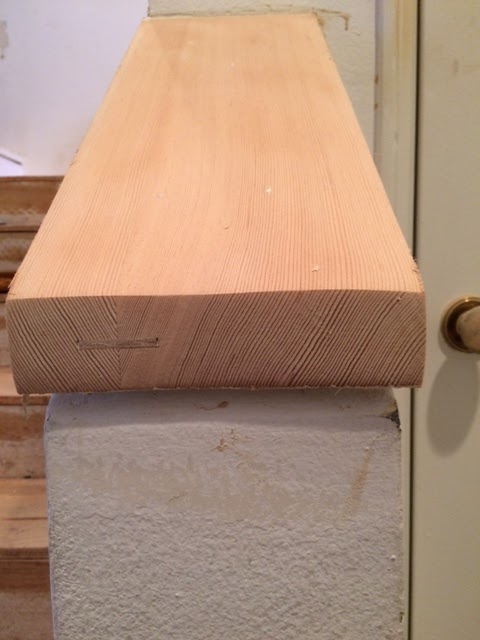
Recall the end grain detail from the rail:

Here is the end grain from the base:


And here is the end grain from a small decorative piece which is off to the right in the first photo:


That is a flat top rail adjacent to the steps. You can see a closet door knob for scale. The wood appears to be doug fir but its growth ring pattern suggests it's intermediate between the rail and the foot rail. Also note that it's made of two joined pieces.

I await Sixty's expert opinion.

Sunday, March 12, 2017

Thank You, Sixty Grit!

[this post continues in part from here]

From an email exchange with Sixty Grit yesterday:

Sixty: You may email me pictures of the railing wood and I might be able to see them better.
A close up of the end grain would be good, as will pictures of the long grain.

Me: [sends two photos]


Sixty: The piece that has been sanded looks like Douglas fir - straight grain, close growth rings - don't let a tree hugger see that - that is beautiful wood.

If you could sand whatever coating is on the end grain I would better be able to see what is going on there - just as there are standards for baluster spacing there are requirements for the type and quality of wood used in handrails - that looks like very high quality wood right there.

Me:

I think you're right about the bottom being Doug fir-I've worked with it before. The rail is more fine grained. Both woods are soft and can be scratched with a finger nail

Sixty: That looks like old growth vertical grain Doug fir. That is beautiful stuff, unavailable these days. The true tell is the aroma - since I can't see color too well - are you familiar with the distinctive smell of Douglas fir? I would say fill and envelope with sawdust and mail it to me, but we would both end up in jail if you did that. Perhaps a trip to the local big box wood store might be in order - they might have some Douglas fir in stock and you could compare and contrast.

As I say, that is high quality stuff right there - well worth refurbishing and keeping.

Me: The growth rings are much tighter in the railing wood.

Sixty: Indeed they are - I guestimate at least 30 rings per inch. Check the smell of both of them - if they smell the same then the railing was made out of old growth stock.

Me: They do smell the same.

Sixty: Well there you go - high grade vertical grain stock used for the railing itself, as required by code, lower grade used for the non-crucial application. I like it - sounds as if the mystery is solved. Well done!

Sunday, September 6, 2015

"That's nice honey"

"Found a beehive while renovating an old house"... via Reddit

Link to source