Showing posts with label sourdough. Show all posts

Thursday, June 25, 2015

Sourdough

With all this weather, especially wind and rain, now is a good time to collect airborne organisms for sourdough starter. Your flour slurry already has its own and can go by itself, but now it can have atmospheric organisms delivered right to it directly shoved in and in very larger number.

The bread will be leavened and flavored and it properties affected by the living organisms of the area. It will be powerful.

But here is the thing about sourdough that books and magazines and internet articles do not tell you outright. Sourdough bread baking works on the principal of continuous production. The sourdough starter is kept at full activity bubbling away hard as it can in cycles. The starter is fed every eight hours or else every twelve, keeping  close a schedule as possible. 

Right off the bat you are dedicated to this dough. You cannot stop. Some bakers call this loose wet sponge the mother, Adam last name unknown the baker in Kitchen Confidential who made the most amazing bread calls it the bitch. Anthony Bourdain's description of Adam and of the bread is one of the more interesting incidents in his book. The point of the episode was knowing your workers. Knowing when something is wrong with them. 

The useful thing I learned from that is Adam tossed soggy mushrooms and bruised fruit and the like into his sourdough starter. And nobody can match Adam's bread. 

It is best suited for bakeries. The yeast that is spread out in dough and on implements that sit in water, attach to dry flour, carried in the air and goes all over the place, and collects, as say, a cheese cellar does.  On your clothes, on your arms, in your hair, everything. 

The starter with its complexity of organisms will flavor the dough on its own if baked right away, and it is good,  people notice a definite difference, but it is days of fermentation that intensifies sourdough flavor.  To do that the dough is chilled and slowed down.  After all that trouble getting organisms to go at top maximum activity and keep them that way, now they're commanded to slow. 

For three days. 

Who does that? 

Bakeries do. Or they should but most don't bother. It is not practical for the home baker. It just isn't. Unless the home baker makes a lot of bread. 

After fermentation of however many days the baker decides, the dough is expected to jump back to life again. And it does. In reverse, encouraged with heat of a warm room.  The baker controls this with temperature, first warmth to keep the starter active, slam on the brakes with coolness for the dough, then accelerate with warmth of room temperature or more by the stove that is warming the whole room. 

Meanwhile the starter is being fed,  and concurrently new bread dough is being prepared for the chiller.  Three cycles being maintained. The starter, the bread dough going into the chiller, loaves being baked three days later. 

Sounds like fun, eh? 

Another way is cheat on all this and use regular yeast the regular way and add a bit of this chilled and inactive starter for flavor. 
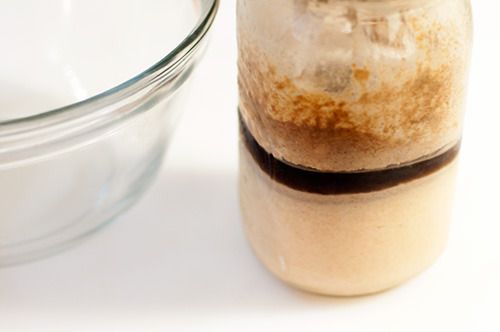

The trouble with that is the starter is inactive, most organisms inside it dead, the flour inside it completely exhausted and inert. To get it active again would take a few days of feeding. It changes the new dough's texture and affects the operation of its commercial yeast, turns the new dough into a substance that feels like clay, the dough becomes inelastic and does not bake properly. It is inert and insalubrious to the dough. 

But man, does it taste good.
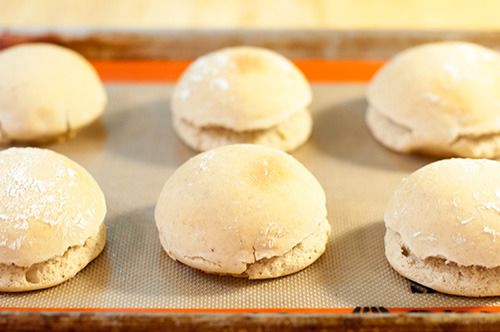

They looked promising but they're horrible buns. Too bad. They are delicious, though. A bit tough to eat. And when you do, you go, "dammit, this is good." You just don't ever taste this. Not ever. A bottom of one of these would go very well with an egg, as Benedict, or with a sauce. Something to loosen it up. 

See, you can get your minds off your government forming policy that is determined by the most cynical and malevolent minds available and having all that litigated by ineluctably sinking to the lowest and  stupidest and most politicized court in all the entire land disputing the first and second definitions of "state" when used interchangeably in the same document. Yes, Assholes, we all know what you mean, but that is not what you said. 

Friday, March 21, 2014

hence

This is three times in a row where I read "hence" when there is no hence about it and each time I wonder, "What am I missing?" I stumble. I stop. Look back. Analyze. And realize, no, it is not me, it is you.

I'm looking for brownies.

The delicious chocolate dessert item, not the out of doors girls' group.

I looked at some four or five recipes online and they all called for baking powder and that is wrong. The whole thing came about by a failed caked, and baking powder would be the most likely point of failure.

So I brought out a book. Baking, James Peterson. It is a very large book so that proves it is official. Kidding. He confirms my idea. No baking powder. But one thing leads to another and I notice for cinnamon rolls he has suggestions for regular yeast and what he calls natural starter.

2 cups natural starter (see page 311)
Making a natural starter, which can be more or less sour, allows you to extract more flavor from the flour than any other method of making breads. Natural (and hence sourdough) is made in two stages.
I am not going to argue with this. But boy, do I see things differently. You do not make a natural starter, you cultivate a sourdough starter by leaving alone flour and water for a few days allowing the yeast and bacteria already on the surface of the flour when it was milled to grow. This seems very odd but it works unfailingly every single time. Various yeast species and various bacteria are growing in there over time, a few days, hence a culture.  

It can also be collected, over time by allowing airborne organisms to fall into your little puddle of flour/water sludge and combine in the puddle with the yeast/bacteria culture already present on the flour, on your body, in your hair, following around you in the air like the Peanuts character Pigpen, I'm imagining, it's all over the place, it's creepy just thinking about it, nonetheless the culture is passively collected and cultivated not actually made.

The flour/water changed because the organisms are devouring it, mating in there, reproducing, budding into it,  using the flour and the water to construct their own bodies, and dying in there. They're farting, gassing up the place, producing cO2 and alcohol then living in that mess, struggling a bit with their ruined environment, the whole thing become quite acidic over time, if allowed a few days fermentation, the organisms collectively create a depleted environment hostile to its own self.

And it is delicious. Yeast death.

It is more or less sour depending upon how long you allow the finished dough to ferment. Fresh flour and water will help the fermented dough burst into new life with fresh food but it also dilutes the fermented sour built up.  I'm saying, you control how sour the loaves are by how long you have the loaves ferment. Days. Say, three. Additionally, the starter itself tends to become more sour over time. It can become too sour.

You do not extract more flavor from the flour. Rather, your good clean freshly milled flour contaminated with yeast and bacteria as it is has fermented and gone sour. Flavor in the form of waste material of biological process is added to it, not extracted from it. Naturally. By itself. You do not extract anything.

Natural (and hence sourdough). Lordy, how do you get sourdough from natural? Nothing is sour until allowed to ferment. Natural does not imply sour.

The term sourdough describes people not dough. That is where the hence belongs, with people.

Yukon gold rush. For their starter to work reliably depended on it staying warm, a particular difficulty in their frozen area. The prospectors mining for gold held a wad of dough in a pouch suspended round their necks kept warm close to their bodies. Their big burly hairy stinking bodies heavily layered with clothing and unlike yourselves they were not in the practice of bathing daily they did smell distinctly of fermenting yeast, hence, Sourdoughs.  The townspeople referred to the prospectors as Sourdoughs when they walked into the shops they blew out the place, and that term was extended to the bread itself later in history, after the isolation of single yeast cell Saccharomyces cerevisiae when everything baking-wise changed. Before that, all bread was made of natural yeast. Now by better living through science we have fast and convenient and reliable yeast uniform in its nature, one-dimensional in flavor, bland actually, but it is fast as far as yeast goes.

In some areas of the world, you can make dough, let it sit there a while outside, and the airborne yeast is so heavy in the air, along with the organisms already present on the milled flour, that the dough becomes inoculated immediately, the organisms spread through the dough rapidly, it rises on its own in the span of a day. Beer is made similarly in such biologically rife places. Oahu is such a place. I tried it. Not dough, but I had active incredibly stinky wet cultures bubbling away within hours. Three separate times.