Showing posts with label moon. Show all posts

Monday, May 30, 2016

flag, Astronauts on the Moon

The large garage door lifted and I walked under it and out like a king except onto an alley facing a parking lot and right off caught glimpse of little brown bunny tucking under a parked vehicle woefully displaced in this urban parking lot. At nine thirty looked up to a blue sky and saw the moon up there like a tiny round cloud just waiting to be noticed by somebody. A woman walking in front of me noticed. "Hey, look at the moon." 

So I did. 

Visitors to the U.S. remark, "Boy, they sure do like their flag. And we do. But not any more than the person saying that. It's just they haven't noticed the same thing in their own country. And if that were uniquely true about Americans as they suppose then these balconies would be covered with flags, and you see only one. Right in the middle. 


My sky. I feel so ensconced. 

I decided to read a book about when America was great. Won't take long, it's a pop-up book.

When was America ever great? A provocative unhappy person asked that on Twitter. 

We could say, maybe back in 1979 when this book was published. When the country was united in a single project. Except for the people against the project, the people who protested spending all that money on space, mostly Democrats,  and insisted better use can be made of it right here and who considered the entire program one gigantic corporate welfare project on an industrial scale. Back when civil rights was a wrenching national issue. When feminism really took hold. Back when free sex opened the door to AIDS. Back then when both parents working and latchkey kids became the norm, during that period of lynchings and riots and anti-war unrest. The golden years when America was great. A nostalgia developed for those less trying times.  


A time when even pop-up books were simple. V-mechanism, V-mechanism, V-mechanism. Except for the pod. We could make this whole book easily in our first class. I'm not knocking it, I'm describing it and encouraging your own abilities.

I saw Obama posters in the windows one time but never any American flags. The business across the street will have a whole block with a line of American flags in a row, but not on the people's balconies. 

Thursday, February 5, 2015

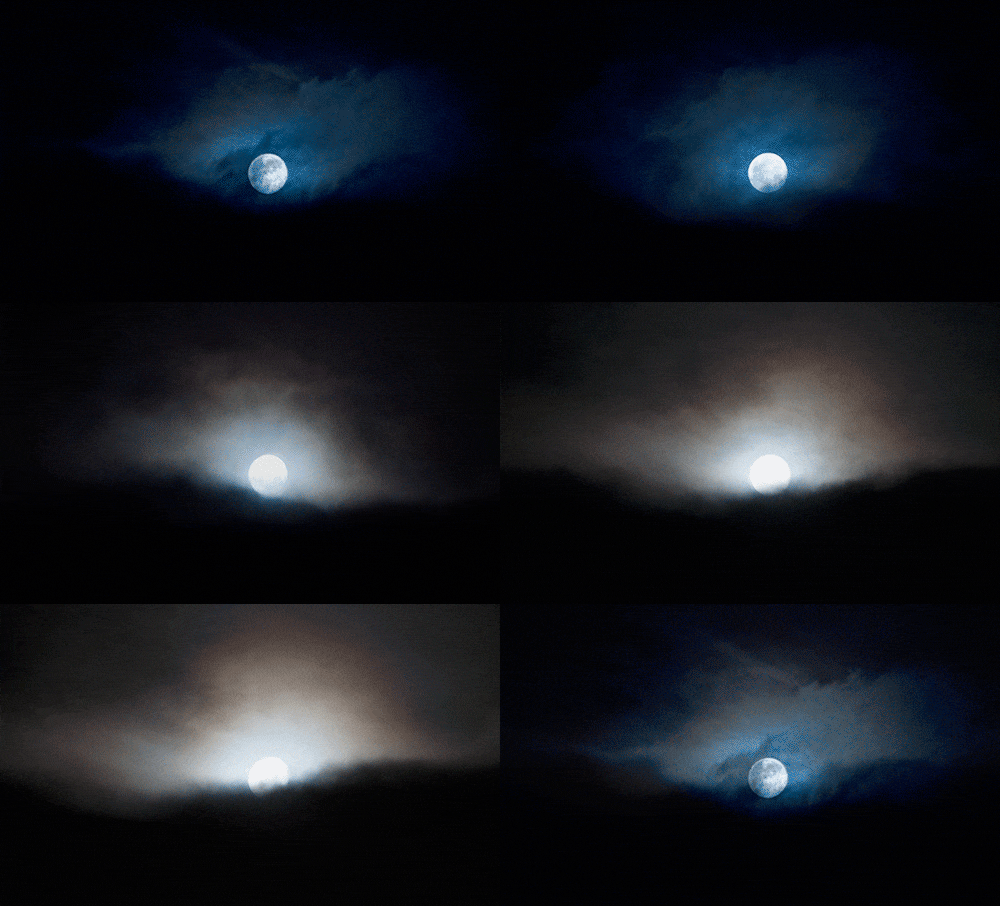
moon


Last night.

I'm pretty sure the moon was put there for our entertainment.

Thursday, June 19, 2014

Planting by the moon


The Old World Kitchen, Elisabeth Luard 1987
There are plenty of crops you can't plant when the moon is waning. The May moon is bad, for example; if you plant beans then, they make a mass of stalks and no fruit. You have to plant seedbeds of onions, lettuce, melon and pumpkins with the waning moon as you do vetch and alfalfa. If the later is planted at any other time, the livestock swell up and die when they eat it. That's the truth. I don't know why it is, but everyone here knows it. [The Pueblo, Ronald Fraser, 1973]
Why?

The simplest most intuitive explanations includes the word "tides." The moon's affect on large bodies of water you see for yourself. The moon's gravity tugs at the bodies of water covering the earth. There is no dispute about that. Ideas about planting by the moon consider the moon tugging at all bodies of water, tugging the water table underneath the soil, tugging the water moisture within the soil. Seeds planted at the time of high tides have more water available to them in the soil. So plant during periods of waxing moon.

Waxing / waning moon also affects weather by affecting moisture in the atmosphere as well.

Conversely, plowing the ground is easier when there is less water in the soil. So plow during periods of waning moon. (This contradicts what my farmer friend just told me, his field was easier to plow under and deeper because it had more water in it. Incidentally, his fields are like powder, soft fragrant powder)
The effect of the phases of the moon on seed germination and growth was first studied by L. Kolisko in 1930. Using wheat, Kolisko found that seeds germinated faster and more prolifically when sown at the full moon. The new moon gave him the most unsuccessful results. Later experiments on cress confirmed Kolisko's findings. Recent studies at Northwestern University, conducted by Professor F. Brown, have shown that, even under equal temperatures, seedlings absorb more water at the full moon than at the new moon. The findings lend credibility to adages that recommend harvesting at full moon. It seems plants have less water content at the new moon phase. Professor Brown went so far as to test plants in a darkened laboratory where they would have no direct access to effects of sun or moon. The plants still responded to the moon phases.
The light reflected by the moon also affects plants.
The lunar month is divided into two basic moon activities: waxing and waning. The beginning of each process is designated by the new and full moon. A full moon occurs when the moon is 180 degrees opposite the sun, in position to receive sunlight over the maximum volume of its surface. A new moon occurs when the sun and moon are so closely aligned that it is impossible for the moon to give off any reflected sunlight. Waxing occurs in the period between the new and the full moon. Waning describes lunar activity between the full and the new moon. When the moon is waxing, it is said to be in its first and second quarters. The waning of the moon brings the phases through the third and fourth quarters of the cycle.
The waxing moon phase is a good time to encourage plant growth and proliferation. The waning moon phase is a useful time to control plant growth and keep down garden pests....
We have already seen evidence asserting growth and liquid absorption peaks at the full moon, and drastically declines during the new moon....
We know from fluctuations in the electrical field of plants, made visible through Kirlian photography, as well as through experience, that plants grow and absorb water at an irregular rate. Rapid growth rate is often followed by a period of rest. Fruit bearing is followed by a period of dormancy. Although we do not know the full effects of the waxing and waning moon on plant growth, we do know that synchronizing phases of plant growth with the phases of the moon produces healthier plants and more abundant yield.
Lunar winds on Earth surface. 
What?
Lunar winds on the earth's surface, moving at l/20 of a mile per hour, are too minute to be felt on the human skin, but they come, as do tides, twice daily. In the morning they flow east, in the evening to the west, influencing the growth of plants as surely as sunshine and rainfall.
KayKeys.net   
http://kaykeys.net/spirit/earthspirituality/moon/moonseed.html

Most other explanations are less useful than this. They rely on ancient knowledge acquired by observations of accumulated result and  passing down the connections they made between moon and the moon passing through Zodiac star constellations, and and planets and all that involving superstition and a good deal of anthropomorphizing plants. Differing methods were developed over time, Synodic, Sidereal and Biodynamic cycles.

the Gardeners Calendar.co.uk  
http://www.the-gardeners-calendar.co.uk/moon_planting.asp

Almanac. com
http://www.almanac.com/content/planting-moons-phase-gardening-calendar